For the Wages of Sin Is Death: Powerful Meaning of Romans 6:23
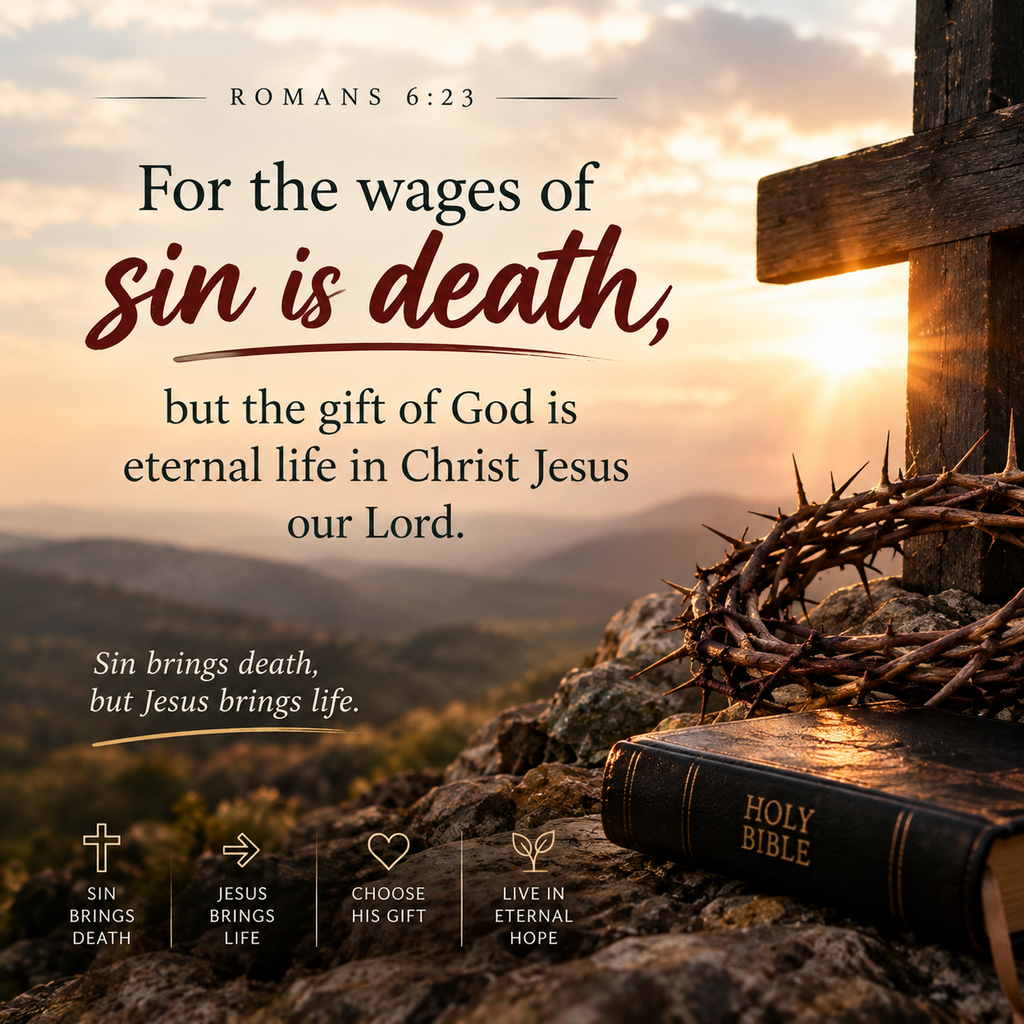
For the wages of sin is death, but the second half of Romans 6:23 reveals the hope at the heart of the gospel: God offers eternal life through Jesus Christ. The verse presents a striking contrast between something humanity earns through sin and something God freely gives through His grace.
Romans 6:23 is short, but its message reaches into some of Christianity’s deepest questions: Why does sin matter? What does sin ultimately produce? Can we earn salvation? And where can we find eternal life?
What Does “For the Wages of Sin Is Death” Mean?
The phrase for the wages of sin is death means that sin has a real and serious consequence. Paul describes sin as something that produces a fitting outcome—death—while eternal life is presented not as a paycheck for good behavior but as God’s gift.
The word “wages” creates an important picture. Wages are something a worker receives because of service. Romans 6 contrasts this earned outcome with God’s gift, which cannot be purchased or deserved. BibleHub’s commentary likewise highlights the deliberate contrast between “wages” and “gift.”
Paul’s point is therefore not simply that individual bad actions have unpleasant consequences. Romans 6 is discussing a deeper question: Who rules your life?
Earlier in the chapter, Paul contrasts being enslaved to sin with becoming servants of righteousness and God.
The Context of Romans 6:23
To understand for the wages of sin is death, it helps to read the surrounding chapter.
Romans 6 asks believers to consider what it means to be united with Christ. Paul explains that Christians are not supposed to treat God’s grace as permission to continue living under sin’s control.
The chapter repeatedly contrasts two ways of living.
One is shaped by sin and ultimately leads to death.
The other is characterized by obedience to God and leads toward holiness, with eternal life as its outcome. Romans 6:22 immediately precedes verse 23 by describing freedom from sin, service to God, holiness, and eternal life.
That context keeps Romans 6:23 from becoming merely a frightening slogan. It is part of Paul’s larger message about freedom, transformation, grace, and new life in Christ.
Why Are the Wages of Sin Death?
The Bible consistently presents sin as more serious than a collection of isolated mistakes.
Sin separates humanity from God’s holy purposes and produces death. Romans 5 connects sin and death, while James 1:15 describes sin as eventually giving birth to death. BibleHub lists these passages among the cross-references for Romans 6:23.
So when Scripture says for the wages of sin is death, it is emphasizing the seriousness of rebellion against God.
Sin may initially appear attractive, harmless, or temporary. But its ultimate direction is destructive.
This is why Romans 6 does not merely tell believers to avoid punishment. Paul points them toward a different Master and a different way of life.
What Does “Wages” Mean in Romans 6:23?
The word “wages” is important because it communicates something earned.
If someone works and receives a paycheck, the payment is owed because of the work performed. Paul uses that familiar idea to contrast the outcome of sin with God’s grace.
Bible Gateway’s NET translation renders the expression as “the payoff of sin is death,” and its note explains that the underlying word can refer to a soldier’s pay and is being used figuratively for the result received from an activity.
That makes the contrast especially powerful:
Sin pays wages. God gives a gift.
The two are not presented as equal transactions.
But the Gift of God Is Eternal Life
The verse does not end with death.
That is perhaps its most important feature.
After declaring for the wages of sin is death, Paul immediately turns to hope:
“but the gift of God is eternal life in Christ Jesus our Lord.”
Romans 6:23 presents eternal life as God’s gift rather than something people earn through moral achievement. Bible Gateway confirms this contrast across numerous Bible translations.
This means Christianity is not ultimately a message that says, “Work hard enough and God might accept you.”
It is a message of grace.
Human beings cannot purchase eternal life. They receive God’s gift through Christ.
Why Does Romans 6:23 Say “In Christ Jesus”?
The final phrase matters just as much as the first two:
“in Christ Jesus our Lord.”
Paul does not present eternal life as an abstract reward. He connects it directly to Jesus Christ.
Desiring God similarly emphasizes that the verse’s three major contrasts are sin versus God, wages versus free gift, and death versus eternal life, with eternal life found in Christ.
The Christian hope is therefore centered on a Person.
Jesus is not simply an example of morality. According to the Christian gospel, salvation and eternal life are found in Him.
This is why Romans 6:23 remains such an important verse for explaining the heart of Christian faith.
Does “Death” Mean Only Physical Death?
The word “death” should not be reduced to physical death alone.
The Bible speaks about death in several related ways, including physical death and separation from God. The contrast with eternal life in Romans 6:23 shows that Paul is discussing something much deeper than the ordinary end of physical life. BibleHub’s commentary specifically notes the importance of understanding death in relation to its contrast with eternal life.
At the same time, this verse should not be used merely to frighten people.
Paul’s purpose is to reveal both the seriousness of sin and the greatness of God’s grace.
The warning and the invitation stand together.
Grace Changes the Direction of Your Life
Understanding for the wages of sin is death should not lead Christians into hopelessness.
Romans 6 actually moves in the opposite direction.
Paul teaches that believers have been freed from sin’s dominion and are called to live differently. The chapter connects freedom from sin with holiness and ultimately eternal life.
Grace is therefore not permission to remain trapped in the same patterns.
It is an invitation into a new way of living.
That means repentance is not merely feeling guilty. It involves turning away from sin and turning toward God.
What Romans 6:23 Teaches Us Today
There are several practical lessons in this single verse.
Sin has consequences. We should never treat sin as harmless.
Human effort cannot purchase eternal life. God’s gift is fundamentally different from wages.
Grace is central to salvation. God gives what we cannot earn.
Jesus is at the center of eternal life. The gift is found “in Christ Jesus.”
Faith should produce transformation. Romans 6 connects God’s grace with freedom from sin and a life increasingly devoted to Him.
These truths make Romans 6:23 both a warning and a message of hope.
How to Reflect on Romans 6:23
If this verse has been weighing on your heart, take a few quiet minutes to reflect on it.
Ask yourself:
- Am I treating sin as something insignificant?
- What areas of my life need repentance?
- Am I trying to earn God’s acceptance instead of trusting His grace?
- What does it mean for me to live under Christ’s lordship?
- How can I respond to God’s gift with gratitude?
You do not need complicated words.
A simple prayer can be:
“Lord, help me recognize the seriousness of sin, receive Your grace with humility, and live faithfully through Jesus Christ. Thank You for the gift of eternal life. Amen.”
Related Bible Verses
If you are studying for the wages of sin is death, several related passages can deepen your understanding.
Romans 5:12 — Connects sin and death entering the human story.
Romans 6:22 — Describes freedom from sin, holiness, and eternal life.
Romans 8:1 — Offers the encouraging message that there is no condemnation for those who are in Christ Jesus.
Ephesians 2:8–9 — Explains salvation in terms of God’s grace rather than human boasting.
John 3:16 — Shows God’s love and the promise of eternal life through belief in Christ.
For comparing Bible translations and reading Romans 6 in its complete context, Bible Gateway provides the chapter and multiple translations.
FAQs About “For the Wages of Sin Is Death”
What does “for the wages of sin is death” mean?
It means that sin has a serious and fitting consequence: death. Romans 6:23 immediately contrasts that consequence with God’s free gift of eternal life through Jesus Christ.
Where is “for the wages of sin is death” found?
The phrase is found in Romans 6:23 in the New Testament.
What are the wages of sin?
According to Romans 6:23, the wages of sin are death. Paul contrasts these wages with God’s gift of eternal life in Christ Jesus.
What is the gift of God in Romans 6:23?
The gift of God is eternal life in Christ Jesus our Lord. It is presented as a gift rather than something earned through human effort.
Why does Paul use the word “wages”?
“Wages” describe something earned as payment. Paul uses this idea to contrast what sin produces with God’s gift of eternal life.
Does Romans 6:23 mean that every sin immediately causes physical death?
No. The verse presents death as the ultimate consequence of sin and contrasts it with eternal life. Its meaning is broader than saying every individual sinful act immediately produces physical death.
Is eternal life something we earn?
Romans 6:23 presents eternal life as God’s gift. Christian teaching therefore distinguishes God’s grace from something people could earn as wages.
How does Romans 6:23 relate to Jesus?
The verse says eternal life is found “in Christ Jesus our Lord.” Jesus is therefore central to the hope offered in the second half of the verse.
What should Christians do with this verse?
Christians can use Romans 6:23 as a reminder to take sin seriously, appreciate God’s grace, trust Christ, and pursue a life of obedience and holiness.
Is Romans 6:23 only a warning?
No. It is both a warning and an announcement of hope. The first half addresses sin and death; the second announces God’s gift of eternal life through Christ.
Final Reflection
For the wages of sin is death, but that is not where Romans 6:23 leaves us.
The verse moves from wages to gift, from sin to grace, and from death to eternal life.
That contrast is the heart of its message.
Sin cannot give us the life we were created to have. Human effort cannot purchase salvation. But God offers something we could never earn: eternal life in Christ Jesus.
For someone carrying guilt, this verse can become an invitation to repentance. For someone struggling with sin, it can become a call to freedom. And for someone who already trusts Christ, it can become a reason for deep gratitude.
The warning is serious—but so is the grace.
And the final word of Romans 6:23 is not simply death.
It is life.
If you found this helpful and are looking for more interesting insights, be sure to .explore :