Uncircumcised Meaning: Definition, Bible & Health Guide
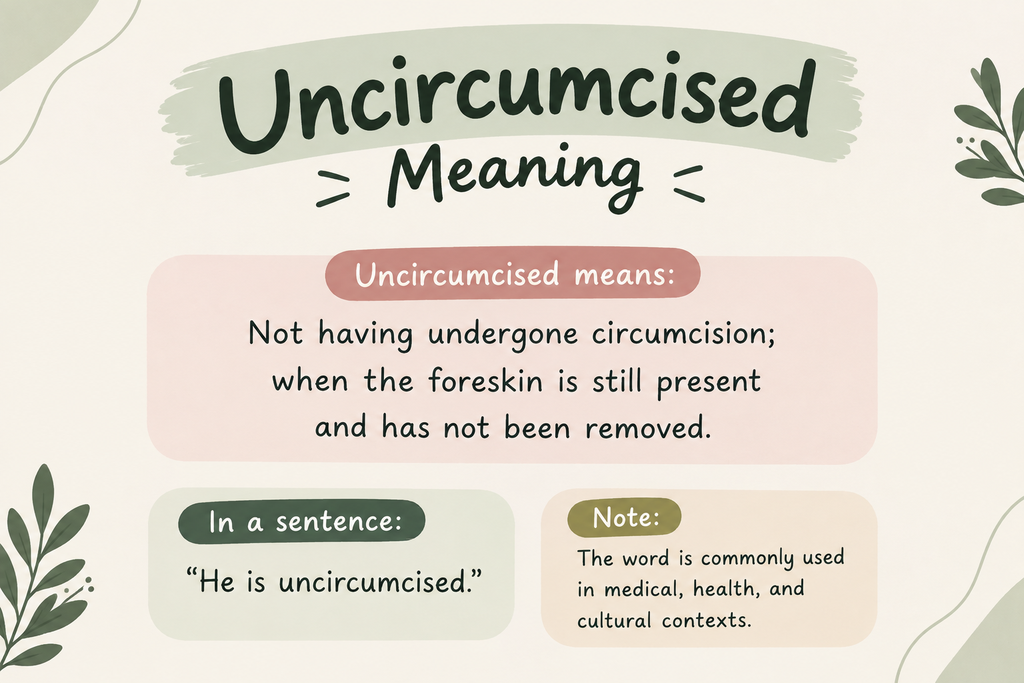
If you have searched for uncircumcised meaning, the word may have appeared in a dictionary, medical article, or Bible passage. In simple terms, uncircumcised usually means that the foreskin has not been removed through circumcision. However, the word can carry a different meaning depending on its context. In biblical language, for example, it can refer not only to physical circumcision but also to spiritual condition, covenant identity, or Gentile status.
If you are searching for uncircumcised meaning, the term generally refers to a male who has not undergone circumcision.
Understanding the context is therefore important. Modern dictionaries primarily give the physical definition, while biblical texts sometimes use the term symbolically.
What Is the Uncircumcised Meaning?
Uncircumcised is an adjective describing someone who has not undergone circumcision. For a male, this generally means the foreskin covering the head of the penis remains intact.
The uncircumcised meaning is straightforward: it describes a penis with the foreskin still present.
Circumcision is a procedure in which the foreskin is surgically removed. Therefore, the simplest distinction is:
- Circumcised: the foreskin has been removed.
- Uncircumcised: the foreskin remains intact.
- Uncircumcision: the state or condition of being uncircumcised.
Cambridge defines the word in relation to having the protective loose skin of the penis still present, while Collins also records historical and theological uses of the term.
Uncircumcised Meaning in Medical Context
In medical language, an uncircumcised male is simply someone who has not been circumcised. Medical terminology may also describe this as having an intact foreskin or prepuce. The National Center for Biotechnology Information uses “foreskin present” and “prepuce intact” as related concepts.
Being uncircumcised is not automatically a medical disorder. An intact foreskin is a normal anatomical condition.
Basic hygiene is important. For older boys and adults, the foreskin can generally be gently retracted when it naturally allows this, cleaned, dried, and returned to its normal position. The foreskin of infants and young children should not be forcibly retracted.
Certain conditions, such as phimosis or paraphimosis, can require medical attention. Persistent pain, swelling, difficulty urinating, unusual discharge, or a foreskin that becomes stuck behind the head of the penis are reasons to seek professional medical advice.
For reliable general health information about uncircumcised anatomy and care, readers can also consult MedlinePlus’ guide to uncircumcised penis care.
Uncircumcised Meaning in the Bible
The uncircumcised meaning in the Bible is broader than the modern dictionary definition.
In the Old Testament, circumcision was associated with God’s covenant with Abraham and his descendants. Because of that background, “uncircumcised” could identify someone who did not belong to the covenant community in the expected physical sense.
But biblical writers sometimes used the word metaphorically. The Bible speaks of an “uncircumcised heart” and “uncircumcised ears” to describe spiritual resistance, disobedience, or a person who is not responding faithfully to God.
This distinction is important because biblical references should not automatically be interpreted as medical statements. Sometimes the physical condition is being discussed; at other times, the physical image is being used to communicate a spiritual idea.
Does Uncircumcised Mean Gentile?
Understanding Uncircumcised Meaning in Simple Terms
In some biblical passages, uncircumcised is closely connected with the idea of being a Gentile, particularly in discussions involving Jewish identity and covenant practices.
The New Testament frequently addresses the relationship between Jews and Gentiles. Romans 2, for example, discusses physical circumcision alongside obedience and the condition of the heart.
Bible reference material explains that “uncircumcised” can therefore have both literal and figurative uses. In some passages, it refers to people who were physically uncircumcised; in others, the emphasis shifts toward spiritual faithfulness rather than an outward physical mark.
So, uncircumcised does not always mean “Gentile.” The surrounding verse and historical context determine the intended meaning.
What Does Uncircumcised Mean Spiritually?
The spiritual use of the term is one of the most interesting aspects of biblical language.
When Scripture describes a heart as uncircumcised, the point is not that the physical body has changed. Instead, circumcision becomes a picture of removing spiritual hardness, rebellion, or resistance to God.
Paul develops this idea in Romans by emphasizing that outward religious identity is not the whole story. The condition of the heart matters. Bible passages concerning circumcision and uncircumcision therefore need to be read within their wider theological context.
This gives the word an important symbolic dimension: physical circumcision concerns the body, while spiritual circumcision concerns the heart and one’s relationship with God.
Uncircumcised vs. Circumcised
The difference is straightforward in everyday medical language.
| Term | Basic meaning |
|---|---|
| Circumcised | The foreskin has been removed |
| Uncircumcised | The foreskin remains intact |
| Circumcision | The procedure that removes the foreskin |
| Uncircumcision | The state of not being circumcised |
Circumcision can be performed for religious, cultural, personal, or medical reasons, and practices vary considerably between communities and countries.
The important point is that the word uncircumcised itself is descriptive. Its meaning does not automatically communicate whether someone is healthy, unhealthy, religious, or irreligious.
Why the Word Has Different Meanings
The meaning changes because language follows context.
In a dictionary, uncircumcised generally describes a physical state.
In a medical discussion, it refers to intact foreskin and may appear alongside topics such as hygiene or foreskin-related conditions.
In a historical or religious discussion, it may identify someone outside a particular circumcision-based covenant practice.
In a biblical or spiritual passage, it may be metaphorical and describe a resistant heart or lack of spiritual responsiveness.
This is why reading the entire sentence or passage is more useful than interpreting the word by itself.
When You May See “Uncircumcised”
You may encounter the word in several situations:
- A medical article discussing foreskin care
- A dictionary definition
- A discussion of circumcision
- A historical description of Jewish or Gentile communities
- An Old Testament passage
- A New Testament discussion of faith and covenant
- A theological explanation of spiritual circumcision
- A Bible study or sermon
The surrounding words usually reveal which meaning is intended.
Related Terms You Should Know
If you’re researching uncircircumcised meaning, several related terms may appear.
Circumcision refers to removing the foreskin.
Uncircumcision refers to the state of being uncircumcised.
Foreskin is the fold of skin covering the head of the penis.
Gentile generally refers to someone who is not Jewish in biblical contexts.
Spiritual circumcision is a theological expression associated with inner transformation rather than physical surgery.
Knowing these related terms makes Bible passages and medical explanations much easier to understand.
Frequently Asked Questions
1. What is the simplest uncircumcised meaning?
The simplest meaning is not circumcised. In males, it generally means the foreskin remains intact.
2. What does uncircumcised mean in the Bible?
In the Bible, it can literally describe someone who has not been circumcised. It can also have symbolic meanings involving covenant identity, spiritual condition, or the heart.
3. Does uncircumcised mean Gentile?
Not always. Biblical passages sometimes use “uncircumcised” in connection with Gentiles, but the two words are not identical. Context determines the meaning.
4. Is an uncircumcised male normal?
Yes. Having an intact foreskin is a normal anatomical condition. Proper hygiene and appropriate medical care are important.
5. What does uncircumcision mean?
Uncircumcision means the state or condition of being uncircumcised. Collins also records its historical biblical use in reference to those who were not circumcised.
6. What is an uncircumcised penis?
It is a penis with the foreskin still present. Medical references also describe this as having an intact prepuce or foreskin.
7. What does “uncircumcised heart” mean?
It is a biblical metaphor. Rather than describing anatomy, it points toward a heart that is spiritually resistant, disobedient, or unwilling to respond to God.
8. Is uncircumcised a medical diagnosis?
No. Being uncircumcised by itself is not a disease or diagnosis. Medical problems can occur in people with or without circumcision, and specific symptoms should be assessed by a healthcare professional.
9. What is the difference between circumcision and uncircumcision in Christianity?
Christian teaching varies by tradition, but New Testament passages such as Galatians 5 emphasize that physical circumcision is not the basis of faith or justification.
10. Why is circumcision mentioned so often in the Bible?
Circumcision was deeply connected with the covenant tradition associated with Abraham and Israel. Consequently, it became an important physical and theological symbol in biblical discussions.
Final Thoughts
The clearest uncircumcised meaning is simply not circumcised, but the word becomes more nuanced when it appears in historical, medical, or biblical writing.
In everyday language, it usually describes an intact foreskin. In biblical passages, however, the term can also relate to Jewish and Gentile identity, covenant practices, and spiritual symbolism. Understanding the context prevents confusion and makes the word much easier to interpret.
Understanding uncircumcised meaning can help readers better understand the terminology and its context.
For biblical study, it is especially helpful to distinguish between the literal physical meaning and the figurative spiritual meaning rather than treating every occurrence as identical.
If you found this helpful and are looking for more interesting insights, be sure to .explore :